Come Learn With Me: A Hallway Find, a Highlighter, and Two Languages at Once
On finding gems, using what you find, and why old books often teach you better than anything out there today :)
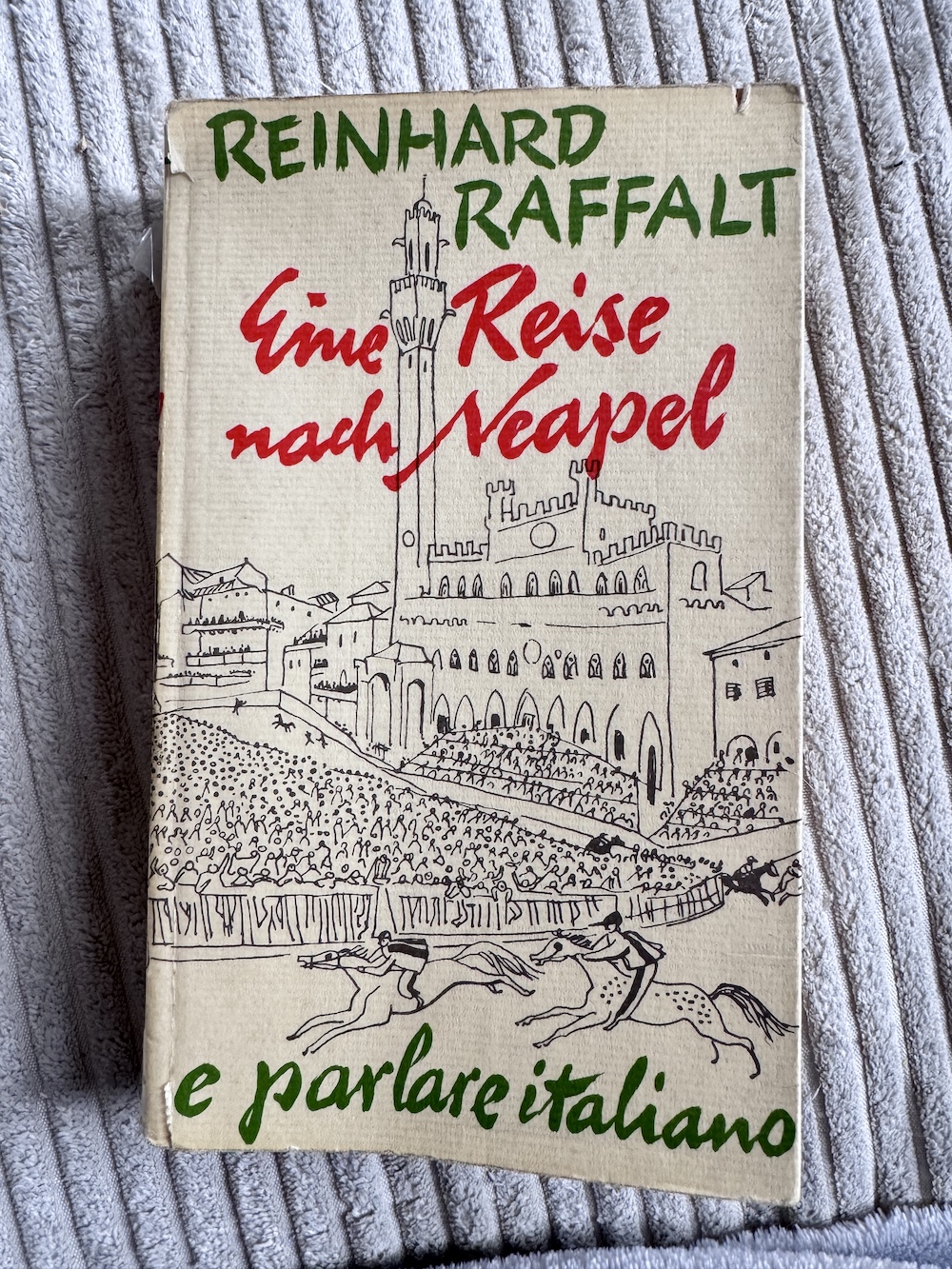
I found this gem of a book in the hallway of my building the other day:
Lately I've been finding a lot of really nice things that way — treasures just sitting there above the mailboxes — and this one turned out to be exactly what I'd been looking for. It's called Eine Reise nach Neapel e parlare italiano by Reinhard Raffalt, and I think it's from the 1960s. It's written in German, and it's meant to teach the reader Italian by taking them through a narrative story. Two birds, one stone — which for me, currently studying for my C1 German exam and learning Italian at the same time, is kind of perfect.
I've only just started it, but I'm already really taken with the style. It has personality! A narrator who speaks to you! A lot of language books nowadays don't have any personality nor try to — they tend to be clean, structured, and a little sterile (and likely the reason why no one likes "textbooks"). But this isn't the case with older books that often have an opinion about a language. They're not afraid to make comparisons, to have a point of view, to talk to you like they know you. This one is quite cute so far and very conversational. You really feel like you're going on a trip with the author.
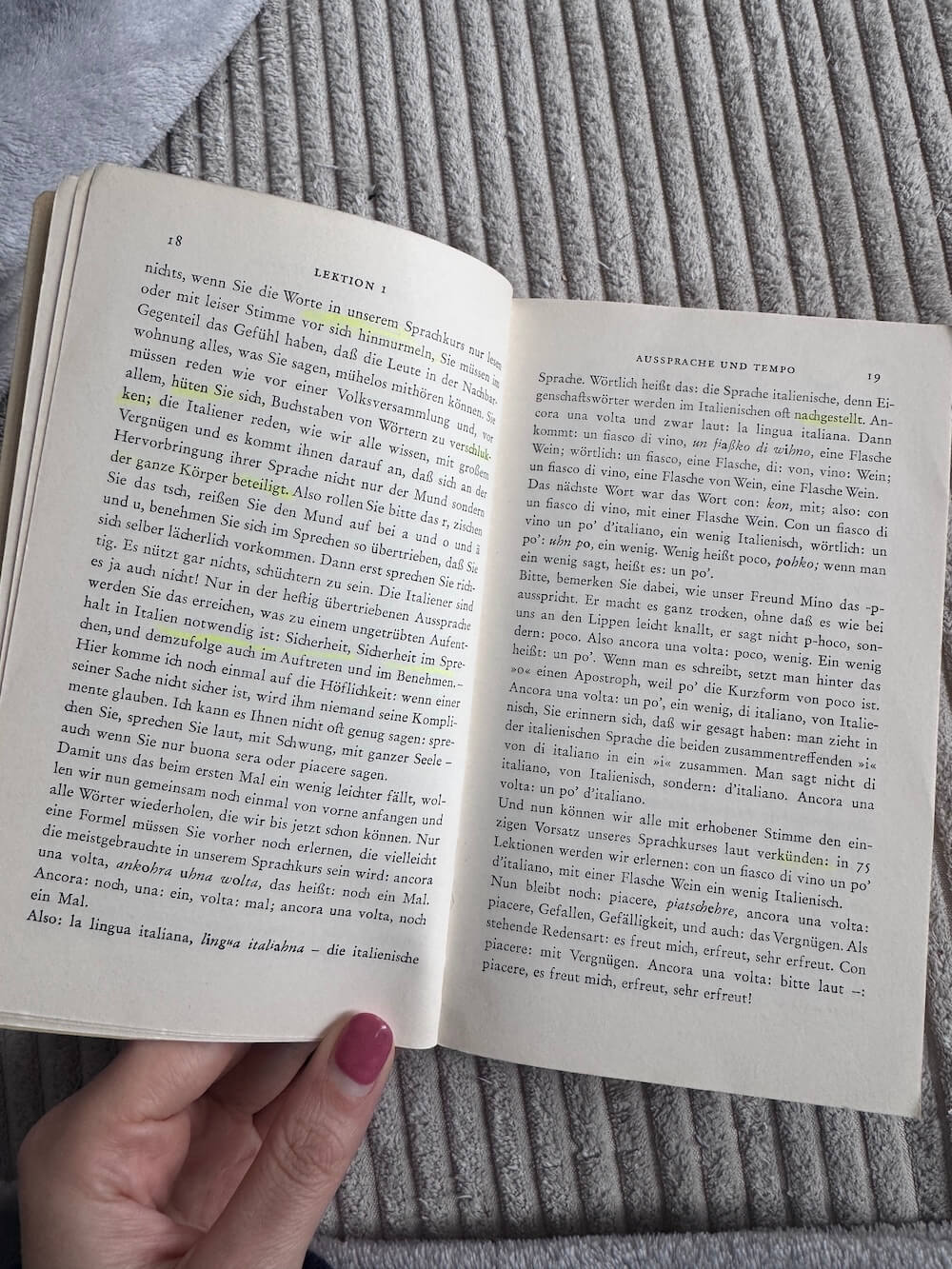
What I love most about the method is the way Italian words are embedded directly into the German text. So instead of stopping to give you a translation, it just flows into the sentence, no tables or line breaks: Ich liebe, I love, Leute, people — ich liebe Leute. It repeats, it builds, it doesn't make you feel like you're stopping to study. You're just reading, and the language is slipping in as narration. I really admire this style, and honestly it's something I've thought a lot about in my own work — I've been developing a Japanese book where I do something similar in a chapter, writing in English and gradually replacing words the reader would already know with Japanese they learned in the book, so it stays readable, in context, without needing a full translation every few lines.
It's always a joy finding one of these older language books – these were once the ways before computers and the internet that everyone learned, and I think learners then were so good at it because they had materials like this. It's truly admirable to me how the authors are not afraid to make comparisons, to have a point of view, and really make you feel like they're with you, understanding intuitively what might be hard, seem illogical, or is interesting, and explaining it to you like a trusted, smart friend.
How I actually go through a book like this
I just started yesterday – I read through the first chapter with a highlighter and marked every German word I didn't know. Right now the Italian is still basic enough that I've got that covered — so it's the German that needs my attention. I got through the chapter, and then this morning I pulled out my iPad and wrote out all the highlighted words on one side of the page, looked them up in an online dictionary, and wrote the translations on the other side.
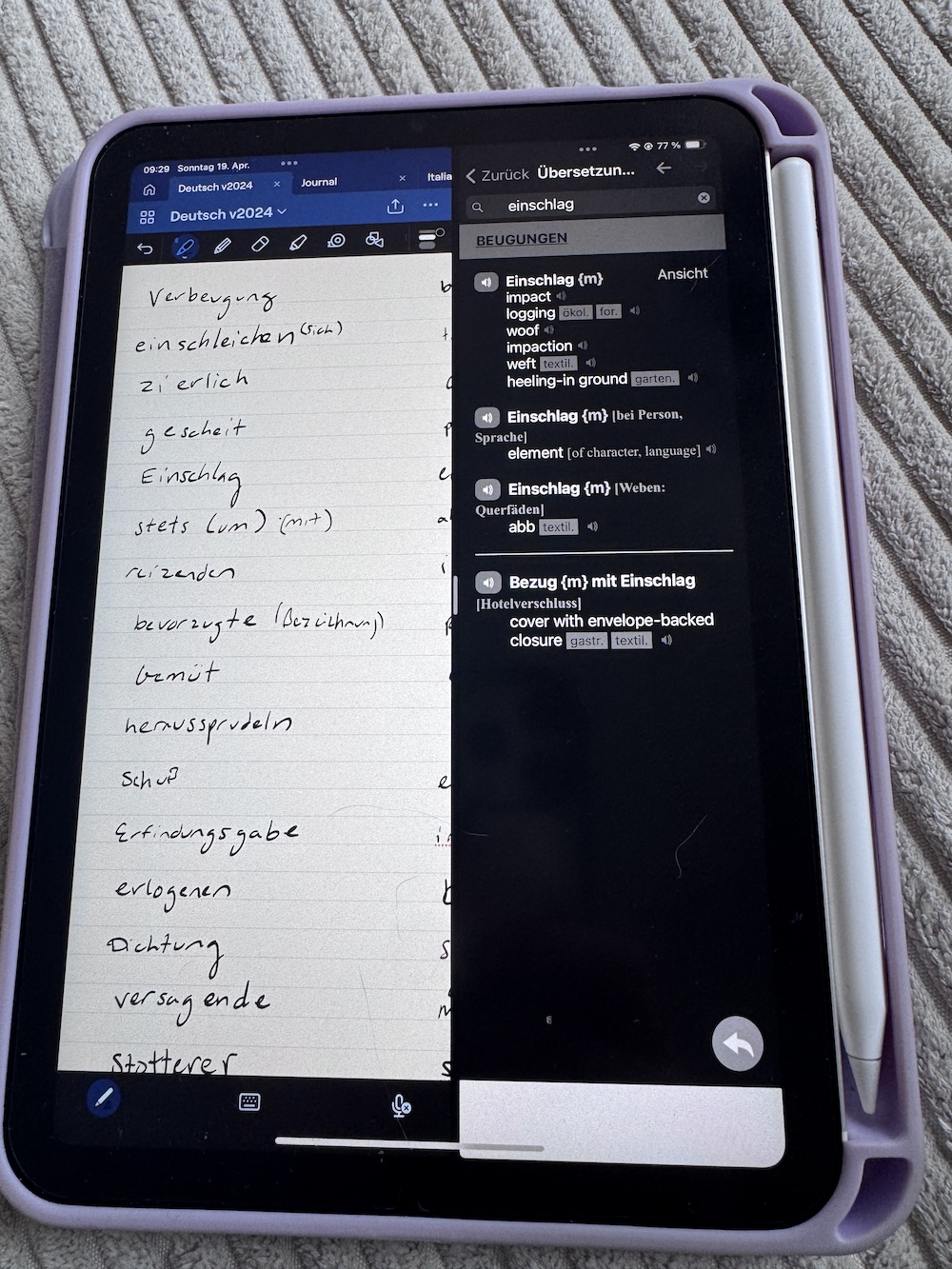
Then I went back into the chapter and read it again — cross-checking the words, making sure I understood why each one was there in context. And I read it out loud. That part is really helpful, both for pronunciation and for retention. Writing the words again would be my next step, and then I'd do what I call mirror work: looking at the German word and translating it to English, then doing it the other way around, English to German, using only my notebook.
And then, very likely, I'd read the chapter again before moving forward. I do this staggered style every time. It's easy to forget the words that came before, even when they reappear later — and they usually do — so I like to make sure I have a good foundation in what I've already covered before moving on. I won't always remember everything perfectly, and that's okay. But I want the previous chapter to feel solid before I take the next step.
Picking books that are in your lane
This is something I talk about a lot, and it applies here too. When I go through a page and there are only a couple of words highlighted, that's a good sign. That means the book is at a good level for me — there's still something to learn, but it's not overwhelming. I'm not stopping every other line to check a dictionary.
But if I opened a book and found myself highlighting almost everything, really struggling to get through it, needing the dictionary constantly — I'd put it down. Not forever, just for now. It would mean it's not in my lane yet. And that's important to be honest with yourself about. Sometimes I highlight words I probably should have learned ages ago, and I highlight them anyway, because this is for me. No ego, just honesty.
There might also be chapters within a book that are harder than others — more words, more complexity — and that's okay too. Those chapters I just repeat more times. But the overall feel of a book should be one of manageable challenge, not constant struggle.
Why this style of book is worth paying attention to
There's something really human about a book like this that I think is uncommon nowadays and quite frankly undervalued. When a book is written in your language, guiding you through another one, and clearly written by someone who understands the gap between the two — who gets what's confusing, what's exciting, what needs to be explained — you feel held. You feel like somebody is there with you in the struggle.
That's exactly what I want someone to feel when they're learning. And it's part of what I think about when I'm working on my own teaching materials — how do you create something that doesn't just inform, but keeps someone intrigued? That keeps words in your brain not because you drilled them, but because the experience of reading was warm enough that they just stayed? I look for this quality in all the materials I use personally and for those I recommend to my clients, of course :)
I'm excited to keep going through this one. Five hundred pages, a dictionary in the back, and two languages to practice at once. I'll take it!
Learn how to find and use the *actually* good stuff
If you want help finding resources that are actually in your lane — for whatever language you're learning — that's exactly what I help with. Book a free 25-minute consultation and let's figure out your starting point together :)
Contact me